Memories of ANZAC Day
All Australians are aware of ANZAC Day, the day we remember those who served, and for many gave their lives for the defence of our country. The first ANZAC commemoration took place in 1916, one hundred and ten years ago. We might wonder, has the way we commemorate ANZAC day changed? Has the way we think about ANZAC day changed?
Recently I was looking through my old school magazine from John Forrest Senior High in Perth, Western Australia, and I came across an article I had written when I was in Year 11, fifty five years ago. It was a fictional story, written to reflect the thoughts and feelings of a Gallipoli veteran at an ANZAC Day parade. It read as follows:
My Mind Travels Back
Even now I remember how, fifty-six years ago, my friends and I fought for our country and home thousands of miles away, on foreign soils. Many of my friends gave their lives; I, my left leg.
Today it does my heart good to see, as I am driven past in my car, the hundreds of young Australians joining together and remembering: Remembering how we – I – fought so that they may live and let live today. In their faces I see one word – ‘thanks’.
Anzac Day, to me, means not only the past, but the present and the future. Remembering that we are Australians and willing to fight for our own country. The peoples’ faces show this. But this is not all I see in peoples’ faces. In some there is a strange mistiness. These, I know, have experienced the sorrow of learning of a lost husband, or father, killed by Turkish bullets.
My mind travels back. The stinking trenches, the bad food, then the Turkish bullet. I see the Turk who shot me. He wasn’t filled with hate, as the enemy was supposed to be. Our eyes met, and I could see that he hated war too. The only other memories of Gallipoli I have are distant views as our hospital ship pulled away for home.
Our thoughts come to mind on Anzac day. Proud thoughts, as our boys from Vietnam march along behind us. They, too, loved their country. Anzac Day is not only a parade. It is the gathering of a nation into a group where love, memories and patriotism prevail. Anzac Day, I know, can’t last forever, but for me and my friends, in our memories, it will.
On reflection, I think that little has changed in regards to the way I viewed ANZAC Day in 1971, and the way most Australians think of it today. There is only one thing I now think differently – fifty-five years later, I now think that the commemoration of ANZAC Day, and all the thoughts, memories and feelings that go with it, can last forever. Today, it is as strong as it always was, and I think it is up to all Australians, encouraged by movements such as Toc H, to make sure it does. The National Museum of Australia web site quotes from the Sydney Morning Herald on 25 April 1916: ‘Australia’s great heart is throbbing today as it has never throbbed before. For April 25 – ‘Anzac Day’ – is a day that will live in our hearts and in our history as long as Australia lasts’.
On a related note, my wife Flora and I have just been to Turkiye to visit places like Ephesus. Everywhere we went, we met friendly people and were impressed with what a clean, developing country it is becoming. Interestingly, the day we were there was Turkiye’s national memorial day, and memorials were adorned with flags and wreaths. March 18 is an important date in Turkish history, known as “Çanakkale Victory Day” in Turkish. The day commemorates the victory of the Ottoman Empire against the Allied Powers during the Gallipoli Campaign in World War I. This historic event has great significance for the Turkish people as it symbolizes the strength, determination and courage of the Turkish soldiers who fought to protect their homeland.
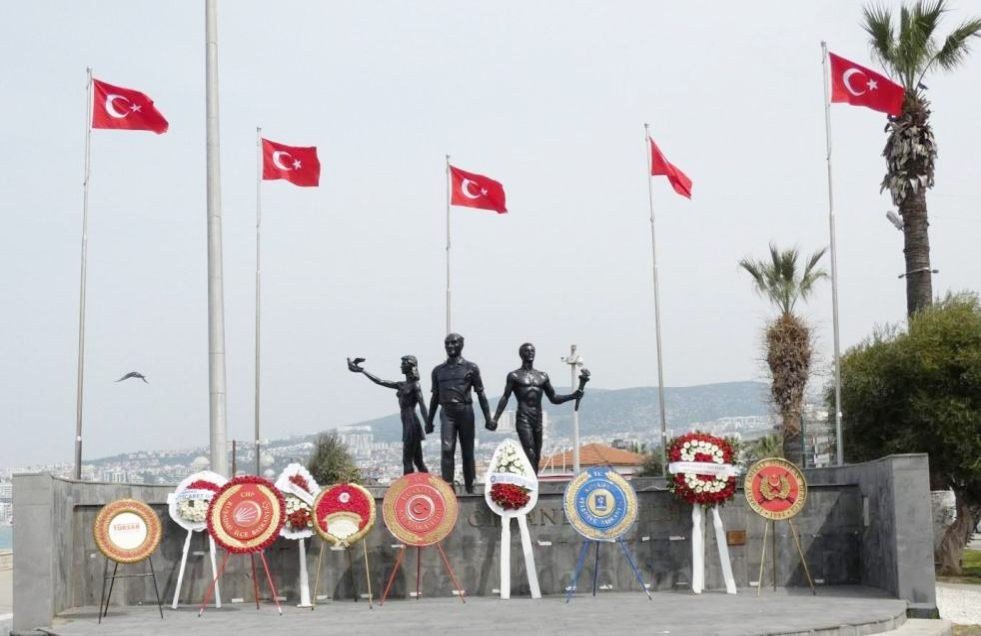
Some we met had heard of ANZAC day, and everywhere we were met with friendliness – the photo was taken in Kusedasi, and we were reminded of the famous words of Mustafa Kemal Attaturk ‘There is no difference between the Johnnies and the Mehmets to us where they lie side by side in this country of ours.’ Again, this is in line with Toc H’s ethos and shows how countries who once enemies,
Owen Nichols
Toc H Australia Council — Brisbane Branch Committee Member
